
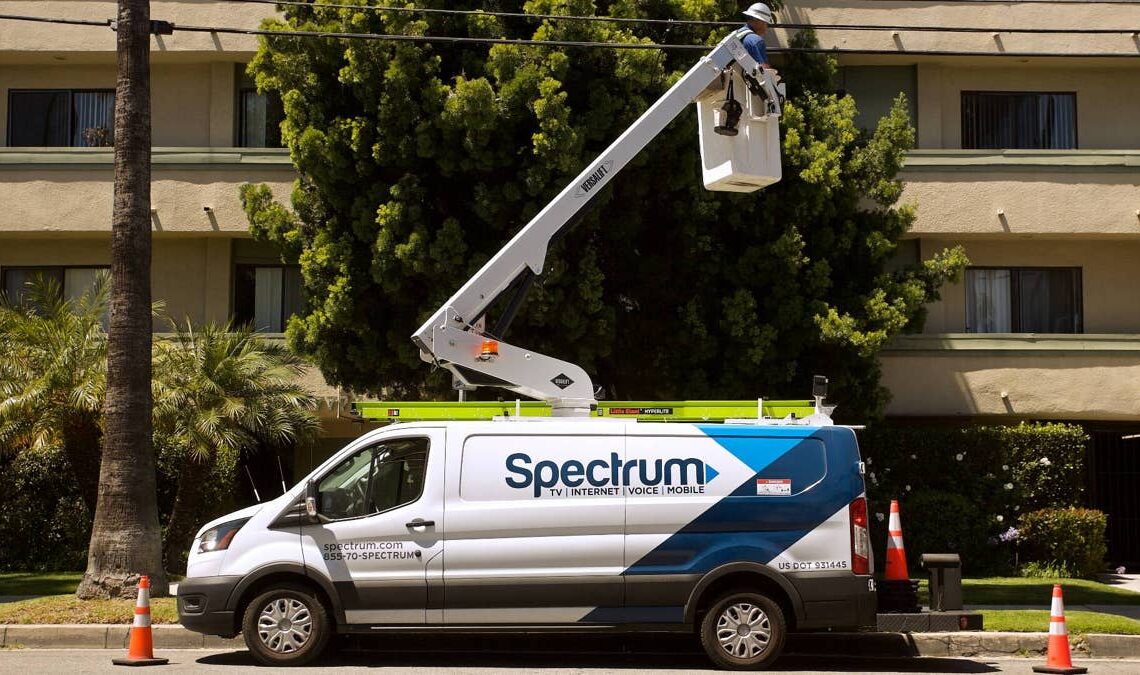
Charter Communications, which operates Spectrum, has completed a billion-dollar acquisition of one of its top rivals as it looks to improve customer retention.
Spectrum’s cable and broadband businesses have faced significant customer losses for years, and the trend has continued in recent months. In the second quarter of this year, the company lost 172,000 internet customers and 21,000 cable TV customers, according to its most recent earnings report.
The losses come as Spectrum faces growing competition from wireless carriers that are increasingly attracting customers to their fixed wireless and fiber internet services with lower-priced plans and bundled deals.
Spectrum is also struggling to keep cable TV customers amid the decades-long cord-cutting trend, in which consumers cancel their cable services and switch to streaming platforms to save money. Against this backdrop, the U.S. pay TV industry lost more than 2 million customers in the first quarter of 2026, according to data from MoffettNathanson shared with TheStreet.
Charter completes Cox Communications acquisition
Amid recent headwinds, Charter Communications has finally closed its $34.5 billion acquisition of Cox Communications.
The deal was first announced in May 2025. At the time, Charter CEO Chris Winfrey said in a press release that combining both companies will “create an industry leader” in telecommunications and “augment our ability to innovate and provide high-quality, competitively priced products” to millions of homes and businesses.
The Federal Communications Commission approved the acquisition in February, requiring Charter to commit to several conditions, such as upgrading and expanding its network in rural areas, onshoring Cox’s offshore jobs and adding safeguards to protect against DEI (diversity, equity and inclusion) discrimination.
Related: Spectrum makes significant decision as customer losses mount
The deal was finalized on Aug. 20 after the California Public Utility Commission (CPUC) voted to approve the transaction on Aug. 13, the last approval needed for the deal to clear.
In a recent press release, Charter Communications revealed that now that the acquisition has closed, it will change its name to Cox Communications within a year, but will continue to operate as Spectrum across all markets.
“The market has changed considerably over the past decade, and regional providers like Spectrum are competing with national and even global connectivity and entertainment companies,” said Winfrey in the press release.
“Today, with expanded scale, we are better positioned to compete and continue investment in our products and service, tools and platforms, and to further the capability and reach of our Spectrum Fiber Broadband Network,” he continued.
The telecom market has indeed become more challenging for operators to navigate in recent years. In January, Bernstein senior analyst Laurent Yoon warned in an analyst note that the telecom industry is “entering a new era of competition” following a difficult 2025, when quarterly results demonstrated “worsening competitive dynamics,” according to a report from Investing.com.
Elliott Cowand Jr./Shutterstock
What the Charter-Cox merger means for customers
The Charter-Cox acquisition has created a cable giant that operates in 45 states, serving about 37 million customers.
Spectrum is now offering Cox internet customers a free year of mobile service to those who aren’t already subscribed to Cox Mobile, according to the press release. Spectrum also plans to roll out “its entire suite of products” to all consumers, including existing customers, in former Cox markets.
Within a year, Spectrum also said that Cox customers will be able to benefit from its “industry-first Customer Service Commitments.”
This includes its 100% U.S.-based customer service team, which is available 24/7. It also promises to resolve service disruptions “quickly, including same-day technician dispatch when requested before 5:00 p.m.; if not, the next day.”
Additionally, Spectrum commits to crediting customers for outages lasting longer than two hours.
“The addition of Cox to the Spectrum footprint is one that can be celebrated by customers, employees and investors alike,” said Winfrey. “Together, we will bring the best products, at the best price, coupled with the highest level of customer service to more customers across our expanded 45-state Spectrum footprint.”
Charter-Cox merger follows growing telecom trend
The acquisition reflects growing consolidation in the telecom market. More telecom companies have recently opted to join forces to better weather elevated competition.
For instance, after merging with Sprint in 2020 for $26 million, T-Mobile acquired US Cellular’s wireless operations for $4.3 billion last August.
Verizon also closed its $20 billion acquisition of Frontier Communications in January. The carrier also announced in June that it is purchasing Carolina West Wireless, which is shuttering its services on Sept. 30.
More Telecom News:
- T-Mobile excludes 2 generous customer perks from new phone plans
- Comcast eyes acquisition of 33-year-old rival amid struggles
- Spectrum makes significant decision as customer losses mount
According to a recent report from consulting firm PwC, 58 U.S. telecom deals were completed through May 2026, showing renewed merger and acquisition momentum.
PwC said this trend was fueled by increased consolidation among fiber operators, intensifying bundled mobile and broadband offerings from telecom providers, and heightened demand for high-capacity networks to support AI workloads.
“Telecom is at an inflection point,” said Chase Bice, U.S. telecommunications sector deals leader at PwC, in the report. “Operators that build, scale, and secure strategic network assets can better position themselves for consumer and AI-driven growth.”
Related: Spectrum rolls out free offer after steep customer losses